
Turning a Blog Into a Book
What I learned in turning a 20 year old blog into a "useful" book

I've been blogging on loufranco.com for more than 20 years. In late 2023, I decided that there was probably something there that could be turned into a book. I set a goal to release a 50-page (10k words) “pamphlet” sized book by July 2024.
A year and eight months later, I have finally finished Swimming in Tech Debt. It’s far more ambitious at almost 55k words. It got this way because I did the marketing first.
Before I get into that, I want to let you know that I opened it up for pre-sales about a week ago. It’s available for $0.99 for about another week. Early sales have been strong:
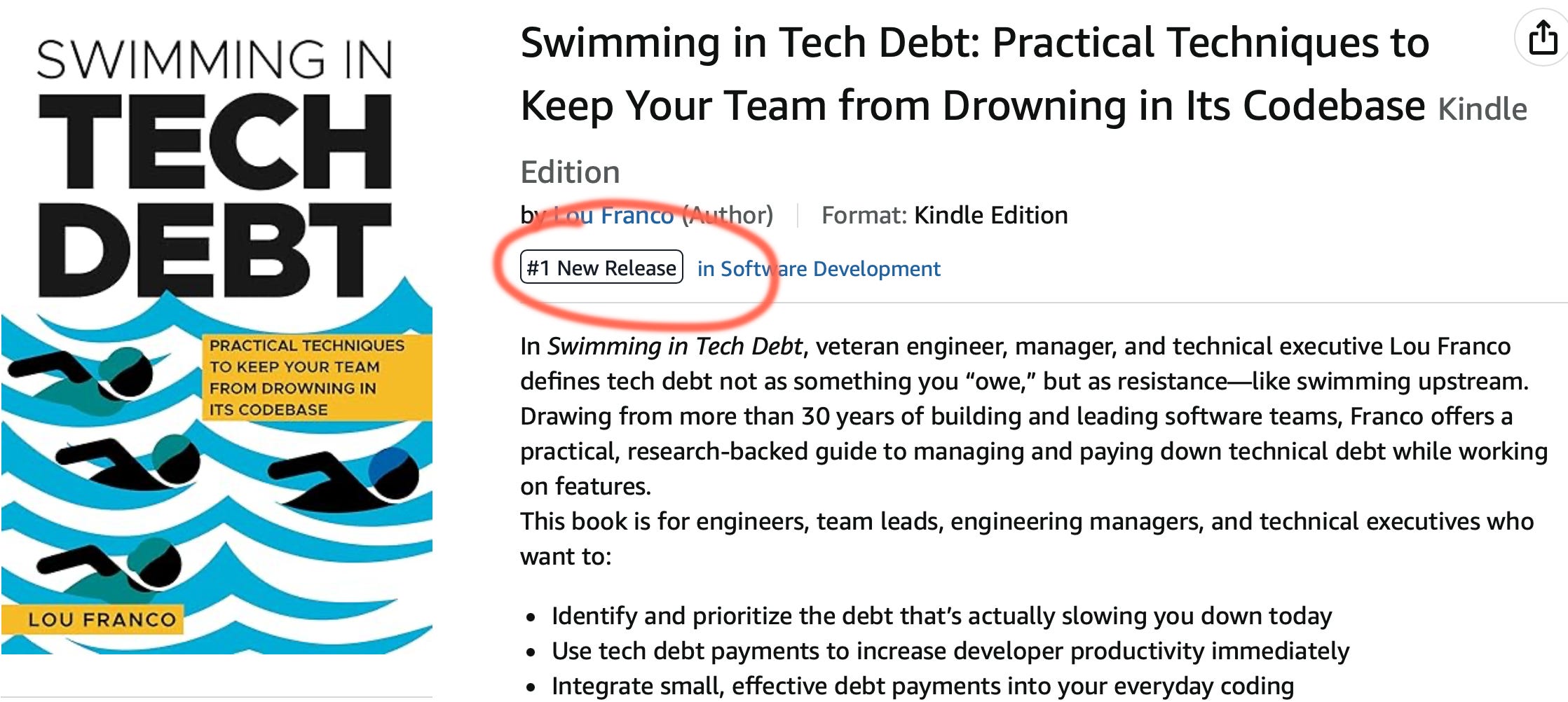
If you have been blogging (or writing here on Substack), you may already be thinking of writing a book. I wanted to share some of the best decisions I made that I think are worth emulating.
I started by re-reading my posts. There were probably 600 at the time (it’s over 700 now). It was good to familiarize myself with my old work. In some cases, my beliefs had changed, which spurred on new posts. I also have some idea which ones have been read more, linked to, or got more search hits.
Then I applied the first lesson I learned from Write Useful Books by Rob Fitzpatrick. He tells you to write a book that is recommended by one audience member to another because the book solves a common recurring problem. You (1) pick an ideal reader (2) that is likely in a group of people like them (3) that has a common problem (4) that they discuss fairly often.
My audience was always going to be software engineering leaders. I have been a part of that audience as a manager, CTO, principal engineer, founding engineer, etc. for more than 25 years. My blog was already an attempt to answer common questions.
Having just reread my posts and thinking about my consulting practice, I realized I had two interesting possibilities: Tech Debt and Developer Productivity Metrics. My breakthrough was when I combined the two. My main topic is Tech Debt, but I weave in the research about productivity metrics, because my main thesis is that tech debt remediation is mostly about improving productivity (with the other effects, of course).
His next suggestion is to make a promise and put it on the cover. My title, sub-title, and cover work together to convey the audience and promise. The subtitle is doing most of the work. It promises “Practical Techniques to Keep Your Team from Drowning in Its Codebase”. The title and cover convey my metaphor of a team making progress by “Swimming in Tech Debt”.
The third (and most important) suggestion in the book is to write in public. I put chapters out within a few weeks of starting. I shared it with my LinkedIn audience and with other developer blogging groups I was in (where sharing was encouraged). The feedback grew the book. I had thought I had about 10k words to say, but I was closer to 20k by the summer. It was also at that time that the writing was discovered by Gergely Orosz, who asked me to pitch a guest article for his newsletter.

That article was the jump start to my email list and this Substack. My email subscribers read chapters and made suggestions for several months. I finished the first draft in December 2024.
Since then, I’ve been doing everything I can to polish the book. I brought in professional editors and did three rounds of edits. I added a couple of chapters and rearranged an entire section in that time as well. I hear that my 20 month timeline is not that unusual (writing the book is not my full-time job). I will say that the editing took a lot longer than I thought it would.
But, that time has given me some time to keep marketing. This post product-design marketing is something I’ll write more about soon. This article is an example of that. I think this is what most people think of when they think of “marketing,” especially non-marketers like myself.
But, when I think of the successful marketing I did for the book, I’d describe it more like this: Study your ideal reader and design a book that solves a problem for them (and then, of course, make sure they know about it).
(Swimming in Tech Debt will be $0.99 until early September)
If you want to talk about a doing a long-form writing project, please reach out.